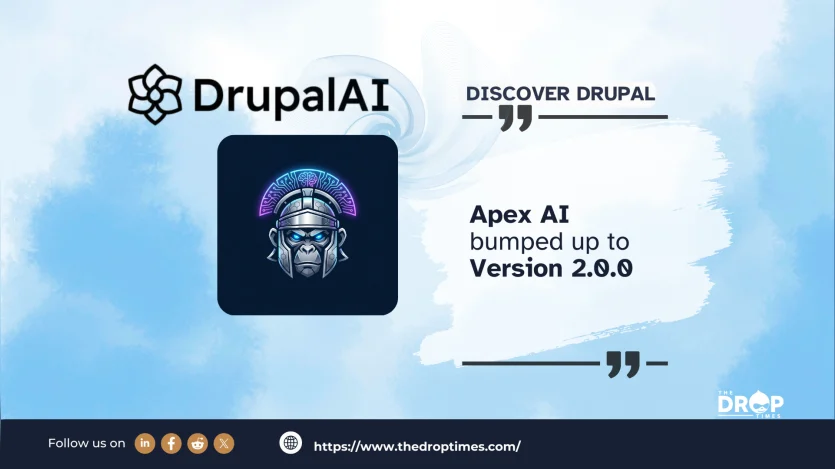
The Drupal AI ecosystem has been moving fast in 2026, but most of the movement has felt fragmented — individual modules, individual provider integrations, individual teams solving the same problems independently. Apex AI 2.0 is the first release that starts to look like infrastructure rather than experimentation. For agencies scoping AI features on Drupal projects, the shift matters.
What shipped in Apex AI 2.0
Apex AI 2.0 adds a provider orchestration layer that sits on top of the existing Drupal AI module ecosystem. The headline changes:
- Nine AI provider integrations — OpenAI, Anthropic, Google Gemini, and six others are now addressable through a single orchestration interface. Switching providers (or mixing them by use case) no longer means rewriting integration code.
- Request routing — you can define rules for which provider handles which type of request. Cost-sensitive tasks can route to cheaper models; latency-sensitive tasks to faster ones; sensitive content to on-premise or private-cloud endpoints. Routing logic is configurable without custom code.
- Observability and audit logging — every AI request and response can be logged with structured metadata: which provider was called, latency, token counts, the requesting user, and the Drupal entity context. This is table-stakes for enterprise clients and something that was previously left entirely to individual teams to bolt on.
- Governance controls — rate limits, content filtering hooks, and approval workflows can be applied at the orchestration layer rather than inside each individual module. One place to manage policy across all AI features on a site.
- Compatibility with the Drupal AI module's existing provider API — existing modules built on the AI module don't need to be rewritten; Apex AI 2.0 sits above that layer.
The release supports Drupal 10 and 11. No specific minimum PHP version was called out in the announcement, but given the Drupal AI module's baseline, PHP 8.1+ is a safe assumption.
Our take
We've been watching the Drupal AI space carefully, and the honest assessment until now has been: interesting, but not production-ready for anything an enterprise client would actually stake a workflow on. The missing pieces weren't model quality or API availability — those are solved by the providers. The missing pieces were the operational concerns: Can I audit what my CMS asked an AI to do and what it got back? Can I cap spend? Can I swap providers when a contract changes or a model gets deprecated?
Apex AI 2.0 addresses all three of those gaps in one release. That's not incremental — that's the difference between a proof-of-concept and something we'd actually put in front of a procurement team.
The multi-provider routing is the most immediately useful feature for agencies. Client AI projects almost always start with "we want to use OpenAI," and almost always evolve into "actually, we need the option to use something else." Contracts change. Models deprecate. EU clients ask about data residency. Having routing logic that's configurable without touching module code means those conversations don't become re-architecture projects.
Audit logging is the feature that unlocks enterprise sales conversations. We've lost AI feature scopes to the question "how do we know what the system did?" more than once. Structured, per-request logging with user context and entity context is the answer to that question. It's also the answer to the compliance question that healthcare, finance, and government clients will always ask. If you're selling Drupal AI features to any regulated-sector client, this is the line item you lead with in the proposal.
Governance controls are worth understanding carefully before you sell them. Rate limits and content filtering hooks sound like checkboxes, but the implementation details matter. We'd want to validate in a real project environment whether the approval workflow hooks are granular enough to satisfy a client's actual review process, or whether they're more of a starting point for custom code. Our instinct: treat them as 80% of the solution and budget for some site-specific configuration work on the first engagement.
What Apex AI 2.0 does not solve: it doesn't replace thinking carefully about what AI features are actually worth building. The observability layer will make it easier to see token costs at scale — and some teams are going to be surprised by what those numbers look like when real editors start using AI-assisted features daily. Budget conversations with clients should include a realistic per-month AI API cost estimate, not just a one-time development cost.
Practical recommendations
If you're actively scoping a Drupal AI project right now:
- Evaluate Apex AI 2.0 as part of your module stack, specifically for the audit logging and routing capabilities.
- Get a staging instance running with real provider credentials before committing to an architecture — the routing configuration UX will tell you a lot about how much custom work you'll need.
- Factor API cost modeling into your proposal. Token costs at real editorial scale are often 3–5× what clients expect from demos.
If you're not actively scoping AI work but run Drupal sites for enterprise clients:
- Watch the 2.0 release notes and the Drupal AI module's issue queue. The governance tooling is maturing faster than most of us expected six months ago.
- Start the internal conversation now about which of your client sites might benefit from AI-assisted content workflows. The infrastructure is getting there; the harder work is identifying the use cases worth building.
If you're on Drupal 9: you have a bigger problem than AI modules. The upgrade path to 10 or 11 is the prerequisite for everything in this space.
Originally referenced: Apex AI 2.0 Expands Drupal AI Integration With Multi-Provider Orchestration on The Drop Times.
If you're planning AI features on a Drupal project — or trying to figure out whether the current tooling is ready for what your client actually needs — get in touch. We're happy to walk through what the stack looks like in practice.